Why You Can’t Ignore Either Users or Search Engines
Let’s be honest—creating website content sometimes feels like walking a tightrope. On one side, you have search engines demanding structure, keywords, metadata, and technical precision. On the other, you have real human beings who just want clear answers, engaging stories, and value they can use right away. Lean too far in either direction, and you fall.
If you write only for search engines, your content becomes robotic, stuffed with keywords, and painful to read. Visitors bounce. Rankings eventually drop. But if you focus only on creativity and ignore SEO fundamentals, your brilliant content may never even be discovered.
So what’s the solution? Balance.
Optimizing your website’s content for both users and search engines isn’t about tricking Google. It’s about alignment. Search engines are designed to reward content that satisfies users. When readers stay longer, click deeper, and share your content, those behavioral signals tell search engines you’re doing something right.
In this guide, we’ll break down 10 powerful, practical tips that help you create content that ranks well and keeps readers hooked. No fluff. No outdated tactics. Just actionable strategies you can apply immediately.
Ready to build content that both algorithms and humans love? Let’s dive in.
1. Start with Search Intent, Not Just Keywords
If keyword research is the compass of SEO, search intent is the map. And without the map, you’re just wandering.
Many website owners make a critical mistake: they chase high-volume keywords without understanding what users actually want when they type those words into Google. But here’s the truth—ranking isn’t just about matching keywords; it’s about matching expectations.
Search intent answers one simple question: Why is someone searching for this?
When your content aligns perfectly with intent, two powerful things happen:
- Search engines rank you higher.
- Users stay longer because you delivered exactly what they needed.
Ignoring intent is like offering a steak dinner to someone who just wanted a snack. It might be good—but it’s not right.
Understanding the Four Types of Search Intent
There are four primary types of search intent:
- Informational – The user wants to learn something.
Example: “How to optimize website content.” - Navigational – The user wants to go to a specific website.
Example: “Ahrefs login.” - Transactional – The user is ready to buy.
Example: “Buy SEO tools online.” - Commercial Investigation – The user is comparing options.
Example: “Best SEO tools for small businesses.”
Each type requires a different content format. An informational query needs a detailed guide. A transactional query may need a product page. If you mismatch the format, rankings suffer.
Matching Content Format to Intent
Before writing anything, Google your target keyword. Look at the top 5 results. Are they blog posts? Product pages? Listicles? Videos?
That’s your blueprint.
If the top results are in-depth guides and you publish a short 500-word article, you won’t compete. If they’re comparison articles and you write a sales page, you’re off track.
Intent-driven content isn’t guesswork. It’s observation. When you align your content type, depth, and structure with what’s already ranking, you dramatically increase your chances of success.
Start with intent. Always.
2. Conduct Smart Keyword Research Without Overstuffing
Keywords still matter. Anyone who says otherwise is ignoring reality. But the way we use keywords has evolved. Gone are the days when repeating a phrase 20 times guaranteed rankings.
Today, keyword optimization is about relevance, context, and natural integration.
Smart keyword research begins with identifying:
- One primary keyword
- Several secondary keywords
- Related semantic phrases (LSI keywords)
Think of your primary keyword as the main topic of conversation. Secondary keywords are supporting details that add depth.
Finding Primary and Secondary Keywords
Start with tools like Google Keyword Planner, Ahrefs, SEMrush, or even Google’s autocomplete feature. Look for:
- Search volume
- Keyword difficulty
- User intent
- Related queries
Let’s say your primary keyword is “optimize website content.” Secondary keywords might include:
- On-page SEO tips
- Content optimization strategies
- Improve website rankings
- SEO content writing
These variations help search engines understand the breadth of your content.
But here’s the key: don’t force them.
Natural Keyword Placement Strategies
Your primary keyword should appear in:
- Title (H1)
- First 100 words
- At least one subheading
- Meta description
- URL slug
After that? Write naturally.
If your content sounds awkward when read aloud, you’re overdoing it. Search engines are smarter than ever. They understand synonyms, context, and topic clusters.
Instead of repeating the same phrase, use variations. For example:
- “Optimizing content”
- “Improving on-page SEO”
- “Enhancing website visibility”
Write for humans first. Refine for search engines second. That’s the balance.
3. Craft Headlines That Attract Humans and Algorithms
Your headline is your first impression. And online, first impressions are brutal. If your headline doesn’t grab attention in seconds, users scroll past.
But here’s the twist: your headline must also satisfy SEO requirements.
So how do you create a headline that appeals to both?
By combining clarity, curiosity, and keyword relevance.
A strong SEO headline includes:
- Your primary keyword
- A benefit or promise
- Emotional or power words
- A number (when appropriate)
For example:
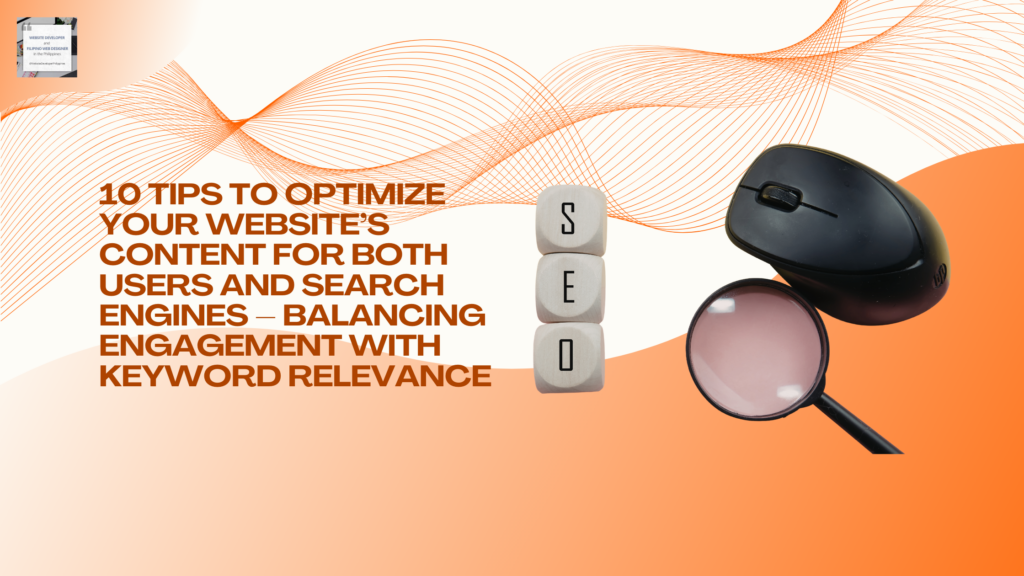
“10 Tips to Optimize Your Website’s Content for Both Users and Search Engines”
It’s clear. It’s benefit-driven. It includes the keyword. And it sets expectations.
Power Words and Emotional Triggers
Words like:
- Proven
- Ultimate
- Essential
- Easy
- Powerful
- Smart
These trigger curiosity and emotion. But don’t overdo it. You want compelling, not clickbait.
Ask yourself: Would I click this?
If the answer is no, revise.
Optimizing Title Tags and Meta Descriptions
Your title tag should stay under 60 characters for proper display. Your meta description should stay under 160 characters and clearly summarize the value of your content.
Think of your meta description as a mini sales pitch. It doesn’t directly impact rankings—but it influences click-through rates. And higher click-through rates can indirectly boost SEO.
Make every word count.
4. Structure Your Content for Skimmability and SEO
Let’s face it—most people don’t read online content word for word. They skim. They scroll. They scan for what matters to them. If your content looks like a giant wall of text, they’re gone within seconds.
Now here’s the interesting part: search engines behave similarly. They crawl your page looking for structure, hierarchy, and contextual clues. That means formatting isn’t just about aesthetics—it’s about performance.
Think of your content like a well-organized house. Clear rooms. Clear labels. Easy navigation. When both users and search engines can move through it effortlessly, everyone wins.
Proper Use of Headings (H1, H2, H3, H4)
Headings are more than bold text. They signal importance and structure.
- H1: Your main title (only one per page).
- H2: Main sections.
- H3: Subsections.
- H4: Supporting details.
This hierarchy helps search engines understand the relationship between ideas. It also makes scanning easy for readers. Someone should be able to scroll through your headings and immediately understand what your article covers.
Here’s a quick example:
- H2: Optimize for Readability
- H3: Short Paragraphs
- H3: Active Voice
- H4: Why Active Voice Improves Clarity
See how organized that feels?
Using Bullet Points, Lists, and Tables Effectively
Lists break complexity into digestible pieces. Instead of burying information in paragraphs, highlight it.
For example:
Benefits of Structured Content:
- Higher engagement
- Lower bounce rate
- Better rankings
- Improved accessibility
You can also use tables to compare information clearly:
| Element | User Benefit | SEO Benefit |
|---|---|---|
| Headings | Easy scanning | Clear hierarchy |
| Bullet Points | Quick understanding | Featured snippet potential |
| Short Paragraphs | Less fatigue | Better dwell time |
Formatting isn’t decoration—it’s strategy. When your content is easy to consume, readers stay longer. And when they stay longer, search engines notice.
5. Write High-Quality, Engaging Content That Solves Problems
Here’s the truth: no amount of technical SEO can save boring content.
You can optimize titles, insert keywords, and structure headings perfectly—but if your content doesn’t genuinely help the reader, it won’t perform long term.
Search engines are increasingly measuring user satisfaction. They look at signals like:
- Dwell time
- Bounce rate
- Click-through rate
- Return visits
And what drives those signals? Value.
Ask yourself: What problem is my reader trying to solve?
Then go deeper than surface-level advice. Don’t just say, “Improve readability.” Show them how. Give examples. Paint scenarios. Make it practical.
Using Storytelling to Increase Dwell Time
Stories create connection. Even in SEO content, storytelling works.
For example, instead of saying:
“Keyword stuffing reduces readability.”
You might say:
“Imagine reading a sentence like this: ‘Our SEO services are the best SEO services because SEO services improve SEO results.’ Feels robotic, right? That’s keyword stuffing in action.”
See the difference? One informs. The other engages.
Stories activate emotion and memory. They make information stick. And when readers feel connected, they stay.
Avoiding Thin and Fluff Content
Thin content is shallow, repetitive, and vague. Fluff content talks a lot but says little.
To avoid this:
- Provide actionable steps.
- Use real examples.
- Include data or case studies when possible.
- Answer follow-up questions within the same article.
Depth builds authority. Authority builds trust. And trust builds rankings.
High-quality content isn’t about word count alone—it’s about substance. But when you combine depth with structure and optimization? That’s where magic happens.
6. Optimize for Readability and User Experience (UX)
User experience isn’t just design. It’s how your content feels to read.
Have you ever clicked on a promising article, only to leave because it was exhausting to get through? Long paragraphs. Complex sentences. Technical jargon. No breathing room.
That’s a UX problem.
Paragraph Length, Sentence Flow, and Tone
Keep paragraphs between 2–4 sentences. Use conversational language. Write like you’re explaining something to a friend.
Instead of:
“Content optimization is a multifaceted strategic initiative requiring comprehensive analysis and implementation.”
Try:
“Optimizing content takes strategy—but it doesn’t have to be complicated.”
Shorter sentences improve clarity. Active voice increases energy. Questions pull readers in.
Like this:
Want to keep readers engaged? Make it effortless for them.
That rhythm keeps attention alive.
Mobile Optimization and Page Speed
More than half of web traffic comes from mobile devices. If your content isn’t mobile-friendly, you’re losing both users and rankings.
Ensure:
- Responsive design
- Fast loading speed
- Readable font sizes
- Proper spacing
Page speed directly affects SEO. Even a one-second delay can reduce conversions significantly.
Think of your website like a store. If the door sticks and customers struggle to enter, many will simply walk away. Speed matters.
7. Use Internal and External Links Strategically
Links are the highways of the internet. They guide users and search engines through related information.
When used properly, links:
- Increase time on site
- Improve crawlability
- Build authority
- Provide additional value
But linking randomly? That helps no one.
Anchor Text Best Practices
Anchor text should describe the destination page clearly.
Bad example:
“Click here.”
Better example:
“Learn more about on-page SEO strategies.”
Descriptive anchor text helps search engines understand context and improves accessibility.
Avoid over-optimizing with exact-match keywords repeatedly. Keep it natural.
Building Topical Authority
Internal linking helps you build content clusters. For example:
- Main Pillar Page: Content Optimization Guide
- Supporting Article: Keyword Research Tips
- Supporting Article: On-Page SEO Checklist
- Supporting Article: Improving Page Speed
This structure signals expertise in a topic area.
External links to reputable sources also boost credibility. It shows you’re backed by reliable information—not operating in isolation.
Link with purpose. Every link should either clarify, support, or expand the reader’s understanding.
8. Optimize Visual Content for Engagement and SEO
Text alone can feel heavy. Visual elements break monotony and improve retention.
But visuals aren’t just decoration—they’re optimization opportunities.
Image Alt Text and File Naming
Search engines can’t “see” images. They rely on alt text.
Instead of:
IMG_1234.jpg
Use:
content-optimization-checklist.jpg
And write descriptive alt text:
“Checklist for optimizing website content for SEO.”
This improves accessibility and image search visibility.
Video and Interactive Elements
Embedding videos can increase dwell time dramatically. Interactive elements like quizzes, calculators, or infographics boost engagement.
Just make sure:
- Files are compressed
- Load times remain fast
- Media supports your message
Visual content enhances user experience. And better experience leads to stronger rankings.
9. Leverage On-Page SEO Elements Properly
Let’s zoom in on the technical layer for a moment. You can write the most engaging, reader-friendly content on the internet—but if your on-page SEO fundamentals are weak, search engines may struggle to interpret it correctly.
Think of on-page SEO like labeling files in a cabinet. If everything is clearly labeled and logically organized, retrieval becomes easy. If not, things get lost.
On-page SEO elements act as signals. They tell search engines what your page is about, how it relates to other pages, and why it deserves attention.
URL Structure and Slugs
Your URL should be clean, concise, and descriptive.
Bad example:
www.website.com/page?id=12345&ref=abc
Better example:
www.website.com/optimize-website-content
Short URLs perform better because they’re easier to read, remember, and share. They also reinforce keyword relevance. Include your primary keyword naturally, but avoid stuffing.
Best practices for URL structure:
- Use hyphens to separate words.
- Keep it lowercase.
- Avoid unnecessary stop words.
- Make it readable for humans.
If someone can look at your URL and instantly understand what the page is about, you’re doing it right.
Schema Markup and Rich Snippets
Schema markup may sound technical, but its purpose is simple: provide extra context to search engines.
It helps generate rich results such as:
- Star ratings
- FAQs dropdowns
- How-to steps
- Product pricing
- Review snippets
These enhanced listings improve click-through rates because they stand out visually in search results.
For example, adding FAQ schema to your page may allow Google to display expandable questions directly in the SERPs. That not only increases visibility but also positions you as authoritative.
On-page SEO isn’t about manipulation. It’s about clarity. The clearer your signals, the easier it is for search engines to reward you.
10. Monitor, Analyze, and Continuously Improve
Optimization is not a one-time task. It’s an ongoing process. Search behavior evolves. Competitors update content. Algorithms change. If you publish and forget, your rankings will eventually slip.
The smartest website owners treat content like a living asset.
Key Metrics to Track
You can’t improve what you don’t measure. Focus on metrics that reveal both SEO performance and user engagement:
- Organic traffic
- Average time on page
- Bounce rate
- Click-through rate (CTR)
- Keyword rankings
- Conversion rate
For example, if traffic is high but dwell time is low, your headline may be strong—but your content isn’t delivering on its promise. If rankings are slipping, competitors may have published more comprehensive content.
Data tells a story. Listen carefully.
Updating Old Content for Better Rankings
Refreshing existing content is often more powerful than publishing new articles.
Here’s why:
- The page already has authority.
- It may already rank for keywords.
- Updating signals freshness to search engines.
When updating:
- Add new data and examples.
- Improve readability.
- Insert new internal links.
- Optimize for additional keywords.
- Remove outdated information.
Sometimes a simple update can move a page from position 8 to position 3. That jump can dramatically increase traffic.
Content optimization isn’t static. It’s a cycle: publish, measure, refine, repeat.
Common Mistakes to Avoid When Balancing Users and SEO
Even with the best intentions, it’s easy to lean too far in one direction. Let’s quickly address the common traps.
1. Keyword Stuffing
Repeating keywords unnaturally destroys readability and trust. Search engines recognize this tactic instantly.
2. Writing for Algorithms Only
If your content sounds robotic, visitors won’t stay. Engagement metrics will suffer, and rankings will follow.
3. Ignoring Search Intent
Creating the wrong content format for a keyword guarantees weak performance.
4. Neglecting Formatting
Dense paragraphs without headings or visual breaks discourage readers.
5. Over-Optimizing Anchor Text
Too many exact-match anchors can look manipulative.
6. Publishing Thin Content Frequently
Quantity without quality weakens authority over time.
The balance comes from remembering one core principle: search engines reward content that satisfies users.
If your focus remains on helping the reader while applying smart SEO fundamentals, you’ll stay on the right track.
Conclusion
Optimizing your website’s content for both users and search engines isn’t about choosing sides. It’s about alignment.
Search engines exist to serve users. That means the better experience you create, the stronger your SEO becomes. When you understand search intent, structure your content clearly, use keywords naturally, and prioritize readability, you build something sustainable.
Think of SEO as the bridge and engagement as the destination. One brings people in. The other makes them stay.
Focus on:
- Intent before keywords
- Clarity before complexity
- Value before volume
- Optimization without over-optimization
If you consistently apply these 10 strategies, you won’t just chase rankings—you’ll earn them.
And when you earn them by genuinely helping your audience, growth becomes predictable, scalable, and long-lasting.
FAQs
1. How many keywords should I use in a single article?
Focus on one primary keyword and several naturally related secondary keywords. There’s no perfect number—prioritize relevance and natural integration over density percentages.
2. Does longer content always rank better?
Not always. Content ranks when it fully satisfies search intent. However, longer content often performs well because it tends to be more comprehensive.
3. How can I tell if my content matches search intent?
Search your target keyword and analyze the top-ranking results. Look at format, depth, and angle. Align your content accordingly.
4. How often should I update old blog posts?
Review high-performing or declining content every 6–12 months. Update statistics, refresh examples, and optimize for new keyword opportunities.
5. Is user experience really that important for SEO?
Absolutely. Metrics like dwell time, bounce rate, and engagement indirectly influence rankings. A smooth, enjoyable reading experience supports stronger SEO performance.
Please don’t forget to leave a review.